Key takeaways
What matters most in this article
- AI automation agencies combine AI systems and workflow automation to reduce repetitive work
- Businesses use AI automation to improve efficiency, scale operations, and reduce manual effort.
- Choosing the right agency requires evaluating technical expertise, integrations, and business impact.
Introduction: What an AI Automation Agency Actually Does
An AI Automation Agency helps businesses use artificial intelligence to automate work that is slow, repetitive, or too complex for traditional automation. In practical terms, that can mean building AI agents that qualify leads, using robotic process automation to move data between systems, or creating AI-powered automation that reads emails, documents, and support tickets before routing them to the right person.
AI Automation Agencies (AIAs) are specialized firms that integrate artificial intelligence and workflow automation into business operations. Unlike a generic software development agency, an AI automation agency is not just building a static app or dashboard. It is designing automation systems that connect with existing systems, make decisions, trigger actions, and improve how work gets done across marketing, operations, finance, HR, IT, and customer support.
This matters because businesses want to reduce manual effort, reduce costs, move faster, and make better decisions. Basic AI automation projects can typically be delivered in 4 to 8 weeks, while more complex enterprise implementations may take 6 to 12 months. In many cases, the first wins appear within 30–90 days if the automation project is focused and the data is usable.
In this guide, we’ll cover what AI Automation Agencies offer, which AI Automation Agency services matter most, how to choose the right partner, what AI Automation services cost, and which warning signs tell you to walk away.
What Is an AI Automation Agency? (And How It Differs from Traditional IT)
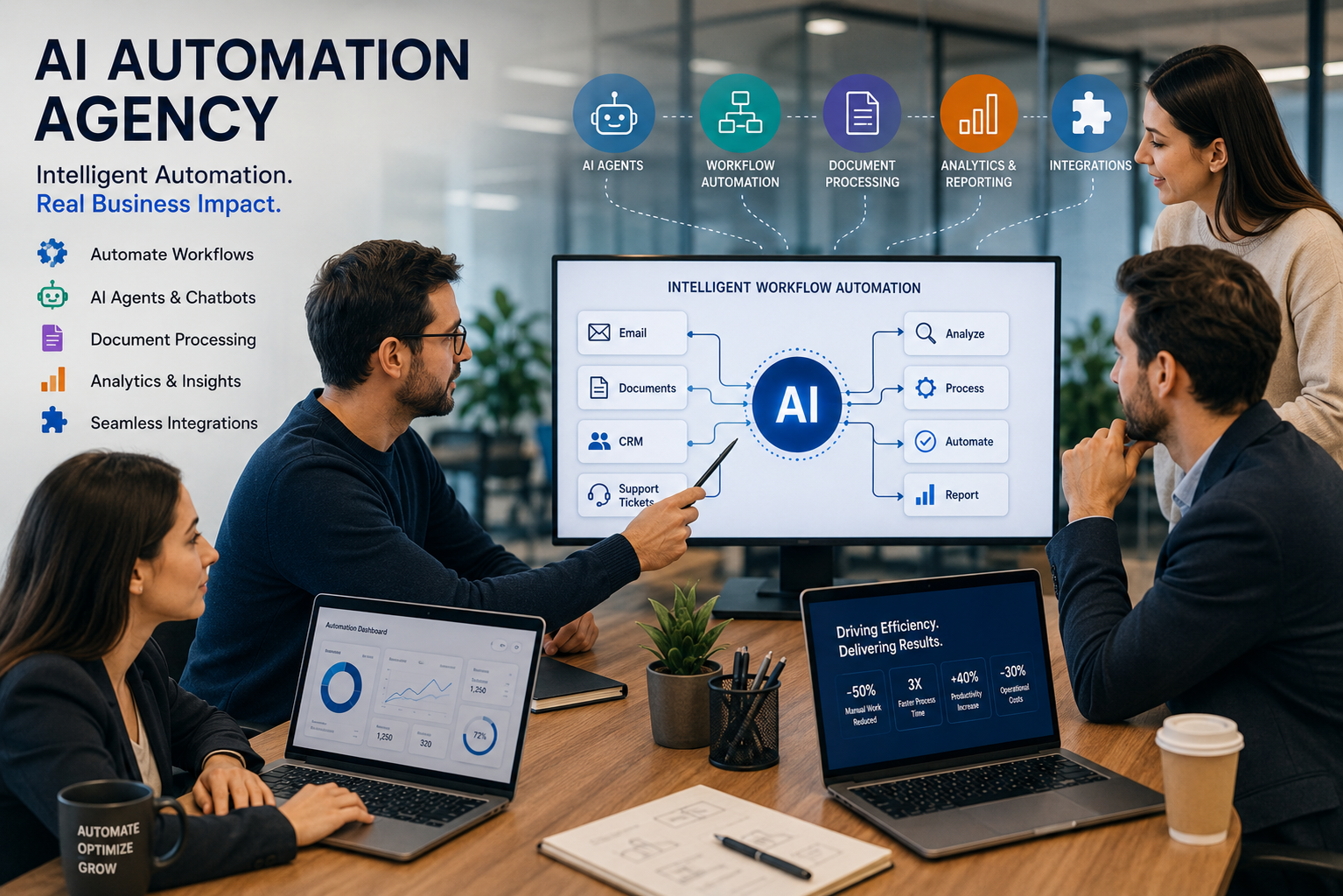
An AI Automation Agency designs, builds, and maintains AI systems that automate real business workflows. These agencies combine automation tools, machine learning, AI models, AI agents, natural language processing, integrations, and workflow optimization to streamline operations.
AI automation combines artificial intelligence with automated workflows to handle both repetitive work and complex tasks, enabling businesses to achieve outcomes that go beyond traditional automation.
A traditional IT or web agency usually builds websites, apps, static dashboards, or one-off scripts. Those projects can be useful, but they often lack learning, adaptive decision-making, and ongoing optimization. AI Automation Agencies design systems using existing AI models and automation platforms to handle repetitive tasks instead of building custom software from scratch every time.
A strong AI Automation Agency typically has these characteristics:
-
It connects to existing business systems such as CRMs, ERPs, helpdesks, data warehouses, finance tools, and communication platforms.
-
It uses AI tools and automation platforms to automate manual tasks such as data entry, ticket routing, reporting, and document processing.
-
It can implement predictive analytics and document parsing to enhance data management.
-
It builds intelligent systems that support decisions instead of only moving data from one place to another.
-
It focuses on measurable ROI, such as a 30% reduction in handling time, 40% faster processing, or 3x more qualified leads.
-
It treats AI projects as ongoing systems that require monitoring, governance, and improvement.
AI automation agencies help organizations automate repetitive work, improve decision-making, and integrate artificial intelligence into everyday operations, leading to faster operations and reduced costs.
Core AI Automation Agency Services & Solutions
AI automation agencies offer a mix of strategy, implementation, and support. The best automation agencies do not start by selling a tool. They start by understanding the process, the people involved, and the business outcome.
Common AI Automation services include:
-
AI workflow automation and orchestration
Workflow Automation connects disjointed software tools to streamline data transfers without manual intervention. Agencies map existing processes, identify bottlenecks, and create automated workflows that trigger the right action at the right time. -
Robotic process automation plus AI
Robotic process automation handles repetitive clicks, form filling, copying, and data movement. AI adds the ability to understand unstructured inputs like emails, PDFs, chat messages, and voice transcripts. -
AI-powered integrations
AI integration connects tools like HubSpot, Salesforce, Slack, Google Workspace, accounting platforms, and project management apps. Connecting software apps for automated workflow can eliminate manual data entry and administrative tasks, saving time. -
Machine learning and predictive analytics
Agencies use historical and real-time data to forecast churn, demand, lead quality, fraud risk, or equipment failure. Implementing automation can provide businesses with real-time data-driven insights for quicker decision-making. -
Custom AI agents and chatbots
Custom AI development can produce sales assistants, customer service bots, HR agents, IT support bots, and operations copilots. These AI agents can answer questions, draft responses, update systems, and escalate exceptions. -
Strategy, consulting, and governance
This includes discovery workshops, automation strategies, AI roadmaps, model selection, security reviews, and compliance planning for GDPR, HIPAA, SOC 2, and similar requirements. -
Monitoring and optimization
Agencies track performance dashboards, retrain models, tune prompts, adjust workflows, and keep AI-powered solutions working as business conditions change.
AI automation systems can streamline processes across various departments, including operations, finance, HR, and IT, allowing businesses to deploy intelligent automation systems that manage workflows automatically.
Examples of AI Automation Agency Services in Practice
Here are practical AI automation solutions you might see in the real world:
-
Customer support automation: An AI chatbot handles up to 60–70% of tier-1 tickets and escalates complex issues to humans with full context. Automating customer service processes with AI can filter incoming requests and draft replies for human review. Implementing AI chatbots allows for 24/7 customer support, providing instant engagement to leads and customers.
-
Marketing automation: AI segments audiences in real time and personalizes email and ad campaigns. This can improve CTR and ROAS and enhance customer engagement when paired with the right AI tools.
-
Sales pipeline automation: AI agents qualify inbound leads, schedule demos, update CRM fields, and reduce manual CRM work by hours per rep each week.
-
Back-office automation: AI reads invoices, extracts data from PDFs, matches purchase orders, and posts to Xero, QuickBooks, or NetSuite with human review for exceptions. Automating data entry and invoice processing reduces human error and administrative bottlenecks in businesses.
AI reduces human error in high-volume tasks, improving overall accuracy in business processes.
How to Choose the Right AI Automation Agency for Your Business
Choosing the right AI Automation Agency is more important than choosing a specific AI tool. Tools change quickly. Your agency’s ability to understand business needs, design automation strategies, and execute safely matters more.
Businesses should assess strategic fit, implementation expertise, and the agency’s ability to deliver measurable outcomes from AI automation solutions when choosing an AI agency.
Start by clarifying:
-
Which KPIs do you want to improve?
-
Which teams are overloaded?
-
Which repetitive tasks consume the most time?
-
Which existing business systems must integrate seamlessly?
-
What data do you already have, and where does it live?
Then evaluate the agency’s technical depth. A reliable AI Automation Agency should understand LLMs, traditional machine learning, RPA platforms, API integrations, data pipelines, AI-powered analytics, and secure deployment.
Ask for real-world success stories with numbers. For example, look for claims like “40% reduction in processing time,” “50% shorter wait times,” or “3.2x more qualified leads.” Vague examples such as “we built an AI company workflow” are not enough.
The right AI Automation Agency should also run a proper discovery phase. That means process mapping, data review, feasibility assessment, and a practical roadmap before development starts.
Security is just as important. Review how the agency handles data access, privacy, audit logs, and compliance. If you operate in the EU, GDPR requirements should be part of the conversation from day one.
Before hiring an AI Automation Agency, businesses should ask about their experience, technical services, and project execution approach to ensure alignment with business needs.
Red Flags: Signs You May Be Talking to the Wrong AI Automation Agency
Use this checklist before signing:
-
They promise “fully autonomous AI” without reviewing your data, tools, risks, or constraints.
-
They refuse to explain their tech stack, model choices, or data handling process.
-
They push one platform as the answer for every business.
-
They have no live case studies, named references, or metrics.
-
Their contract has unclear scope, missing acceptance criteria, or no support plan.
-
Their communication is slow, vague, or overly technical without business context.
Warning signs that indicate a wrong choice of AI Automation Agency include a lack of transparency, poor communication, and failure to provide case studies or references.
Key Questions to Ask Before You Sign
Ask potential AI agencies these questions:
-
Have you completed AI automation projects similar to our industry or workflow?
-
What metrics improved, and over what timeframe?
-
Which AI models, automation tools, RPA platforms, and integration platforms do you use?
-
Why are those the right AI tools for this project?
-
Who owns the workflows, prompts, documentation, and code?
-
What happens if we end the partnership?
-
What does the timeline look like for a pilot versus full-scale automation?
-
How will you measure success?
-
What dashboards will we receive?
-
What support is included after launch?
A good agency should answer directly and show how the work connects to business growth, not just technical novelty.
Implementation Timeline: How Long AI Workflow Automation Really Takes
The timeline for implementing AI workflow automation varies based on the complexity of the workflow, data quality, and the number of systems that require integration, with small projects launching in a few weeks and larger initiatives taking 6 to 12 months or longer; top AI automation agencies and other experienced AI automation companies can often launch small, focused automation projects quickly when data and integrations are straightforward.
Small projects, such as a single support chatbot or basic lead scoring workflow, can launch in 2–6 weeks when integrations are limited. Basic AI automation projects can typically be delivered in 4 to 8 weeks, while more complex enterprise implementations may take 6 to 12 months.
Most mid-scale AI automation projects take about 3 to 6 months to complete, covering phases such as discovery, data preparation, model development, and deployment.
Large cross-department programs involving advanced automation, multiple AI agents, RPA, security reviews, and enterprise systems can take 6–12 months to mature and stabilize.
A credible agency will usually recommend phased rollouts: quick wins first, deeper ai driven automation later.
From Pilot to Scale: Typical AI Automation Project Stages
Most AI projects follow a similar path:
-
Discovery and assessment
The agency maps processes, audits data, reviews systems, and estimates ROI. -
Design and prototyping
The team defines workflows, prompts, models, integrations, and pilot agents. -
Build and integration
Developers implement automations, connect APIs, configure RPA, and set up logging. -
Testing and validation
Humans test outputs alongside automated checks to confirm accuracy, safety, and reliability. -
Launch and continuous improvement
The system rolls out in phases, users provide feedback, and the agency tunes models and workflows.
AI automation helps organizations streamline workflows, improve accuracy, and increase efficiency throughout an organization by automating repetitive tasks and decision-making processes.
Pricing: How Much Do AI Automation Agencies Cost?
Pricing depends on scope, complexity, data readiness, and support needs. If you are researching AI automation services cost or automation services cost, use ranges as a starting point rather than a final quote.
Typical pricing looks like this:
| Project type | Typical cost range | Common scope |
|---|---|---|
| Small pilot | $2,000–$10,000 | One AI agent, simple chatbot, or basic RPA workflow |
| Mid-sized engagement | $10,000–$50,000 | Multiple workflows, several integrations, department-level rollout |
| Enterprise program | $50,000+ | Advanced AI systems, compliance, custom data work, multi-department deployment |
| Ongoing retainer | A few thousand dollars per month upward | Monitoring, optimization, updates, support, reporting |
Some automation companies offer milestone-based or performance-based pricing tied to cost savings, response time, revenue lift, or processing speed.
Ask for a clear breakdown that separates discovery, build, integrations, testing, training, maintenance, and support.
When Your Business Actually Needs an AI Automation Agency
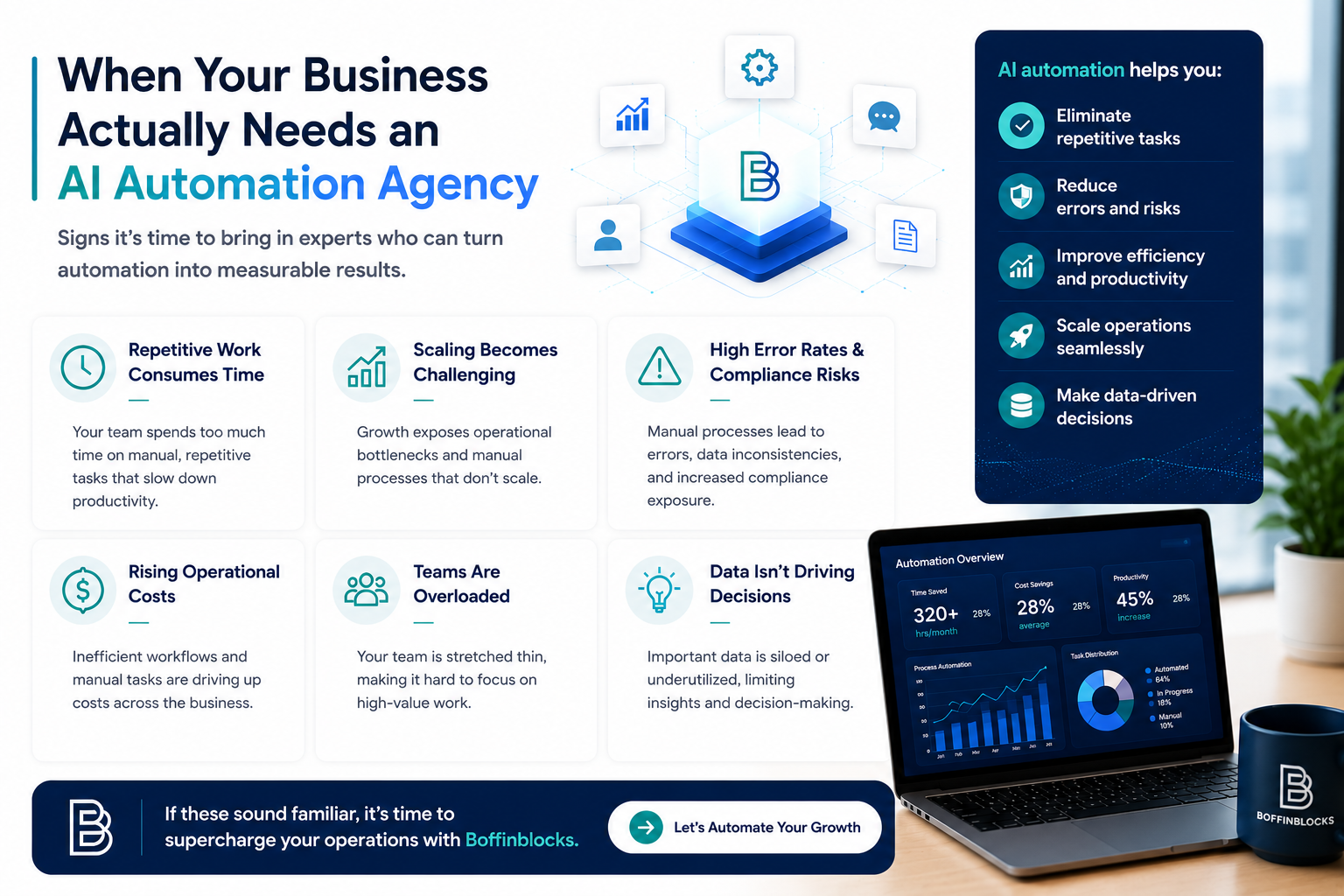
Not every business needs an agency immediately. But if your team is drowning in manual effort, an AI Automation Agency can be the difference between adding headcount and building scalable systems.
You may be ready if:
-
Your team repeatedly does manual data entry, copy-pasting, tagging, or reporting.
-
Support staff answers the same questions all day.
-
Sales reps spend too much time updating CRM records.
-
Hiring cannot keep pace with the workload.
-
Leadership wants AI and automation but lacks in-house expertise.
-
Tools are scattered across CRM, helpdesk, billing, spreadsheets, and email.
-
Isolated AI tools have failed because they were not connected to real business workflows.
AI automation agencies help organizations improve efficiency by connecting work across teams. The objective is to reduce repetitive operational work so teams can focus on higher-value tasks and decision-making.
Preparing Internally Before You Engage an AI Automation Partner
Before you implement AI automation, prepare the basics:
-
Document current workflows in plain language.
-
List the systems used by sales, marketing, support, operations, finance, HR, and IT.
-
Identify delays, rework, errors, and repetitive handoffs.
-
Gather sample data such as anonymized tickets, call transcripts, forms, invoices, or process logs.
-
Choose internal champions who can make decisions and support adoption.
-
Define 2–3 priority metrics, such as response time, cost per ticket, conversion rate, processing time, or operational costs.
This preparation helps an agency deliver flexible AI solutions that fit your business needs rather than forcing a generic platform into your process.
Conclusion: Turning AI Automation Into a Sustainable Advantage
AI automation agencies exist to match AI agents, automation platforms, machine learning, and automation services with real business problems. The best ones do not chase hype. They build AI solutions that reduce manual work, streamline operations, and create measurable ROI.
Start with one focused workflow. Prove the value. Then scale operations across departments in deliberate phases. This approach makes AI-powered automation safer, easier to adopt, and more likely to produce measurable business results.
If you are considering an AI Automation Agency, begin with a workflow audit. Map where your team loses time, where errors happen, and where better automation solutions could improve efficiency. That will show you whether you need a simple automation fix, custom AI development, or a full digital transformation partner.
About the author
Boffinblocks Team
Admin
I am the Author of this blog
READY TO AUTOMATE YOUR WORKFLOWS?
Build AI workflows that reduce repetitive work and scale operations faster.
From workflow automation and AI agents to document processing and custom integrations, Boffinblocks helps businesses build practical AI systems that create measurable operational impact.


